 Fraunhofer Institute for Integrated Circuits IIS, Division Engineering of Adaptive Systems
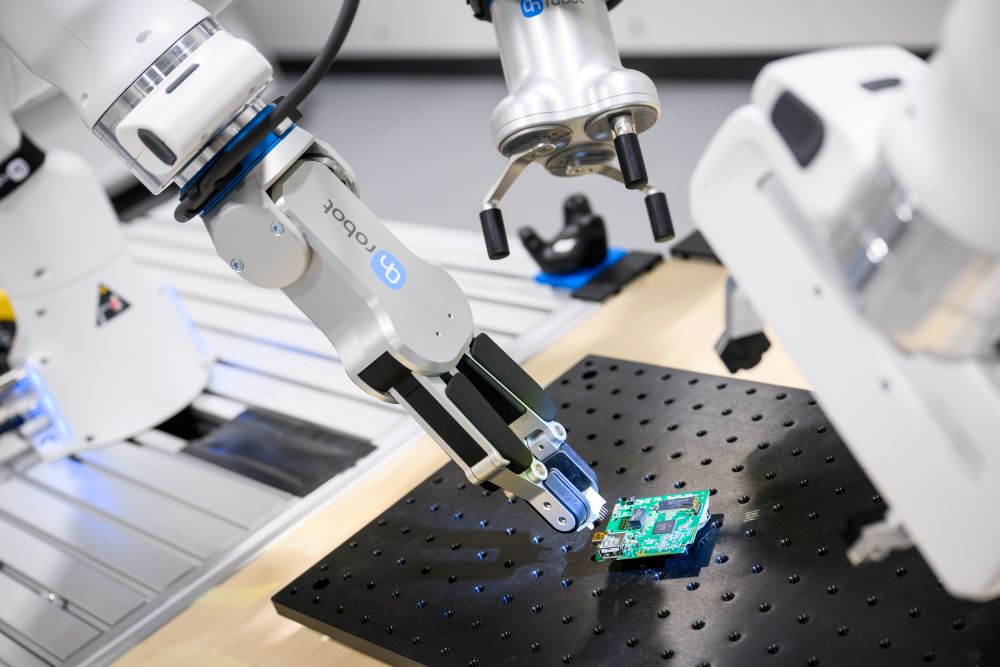
Today, there are already over four million industrial robots operating in factories around the world, almost 300,000 of them in Germany – and this robotic workforce continues to grow rapidly. Yet the performance of these robots is reliant on their underlying programming. The usual approach involves defining trajectories within the workspace, translating these trajectories into programs, and executing them on the robot using a programmable logic controller (PLC). Although this method is highly transparent and ensures excellent repeatability, it lacks flexibility and is not readily adaptable to a changing environment.
The answer lies in adaptive robotics, which allows robotic systems to adapt flexibly to new circumstances. Instead of hard-coded trajectories, adaptive robots operate based on real-time data, using internal information such as joint angles or forces as well as external sensor data from cameras, laser scanners, radars, or positioning tags. Additional sensor technology and intelligent data processing enable the robots not only to handle hard-to-automate tasks but also to reduce programming times, expenditure on safety devices, and need for mechanical engineering design. Adaptive robotics makes industrial processes not only more versatile but also more economical.
